Crunchbase tracks startups, funding rounds, and investor profiles. Companexia provides official government data for UK and Swiss companies: filed financial accounts, ownership networks, and official documents. Different data, different purpose. All free. New countries coming soon.
See a real company profile
A quick walkthrough of the live company profile, financial health view, ownership graph, and document viewer.
Crunchbase and Companexia serve different needs. One tracks the startup ecosystem. The other provides structured government data.
These are fundamentally different tools. Crunchbase excels at tracking the startup and venture capital ecosystem. Companexia excels at structured company intelligence from official sources.
| Feature | Crunchbase | Companexia |
|---|---|---|
| Official government registry data | ||
| Filed financial accounts | ||
| Calculated financial ratios | ||
| Ownership network graph | ||
| Official filing documents | ||
| Funding rounds and investors | ||
| Startup profiles and descriptions | ||
| Global company coverage | ||
| Company event timeline | ||
| Person search across entities | ||
| Sales prospecting tools | ||
| Free access (no limits) |
The gap is not better profile copy. It is official company records, filed accounts, and verifiable ownership data.
Crunchbase profiles are useful for discovery, but they are not a registry record. Companexia starts with official UK and Swiss filings, so status, officers, and company facts are tied to source data.

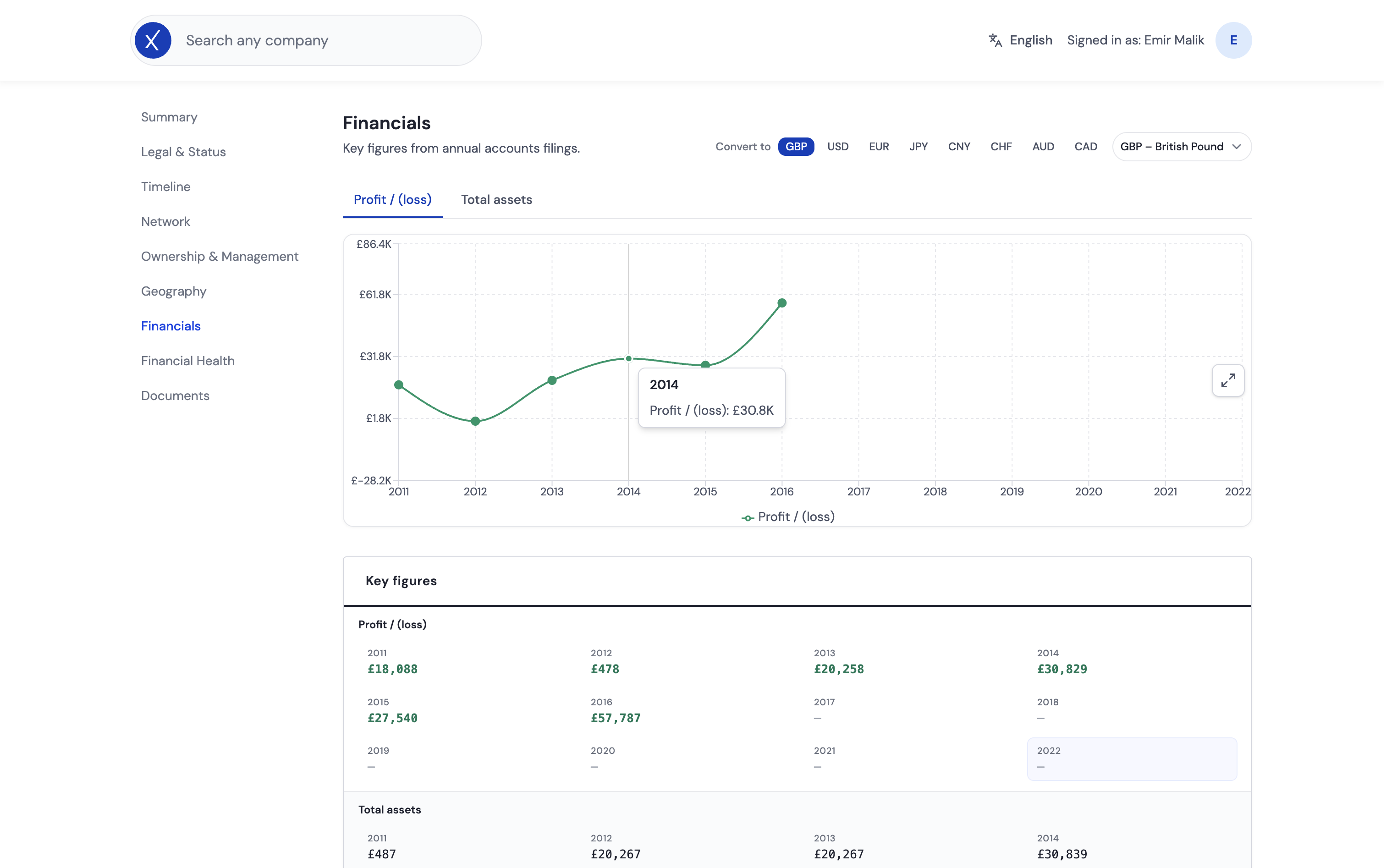
Crunchbase does not provide filed annual accounts or filing-derived ratios. Companexia extracts the numbers from official accounts and presents them as structured financial history rather than estimated profile data.

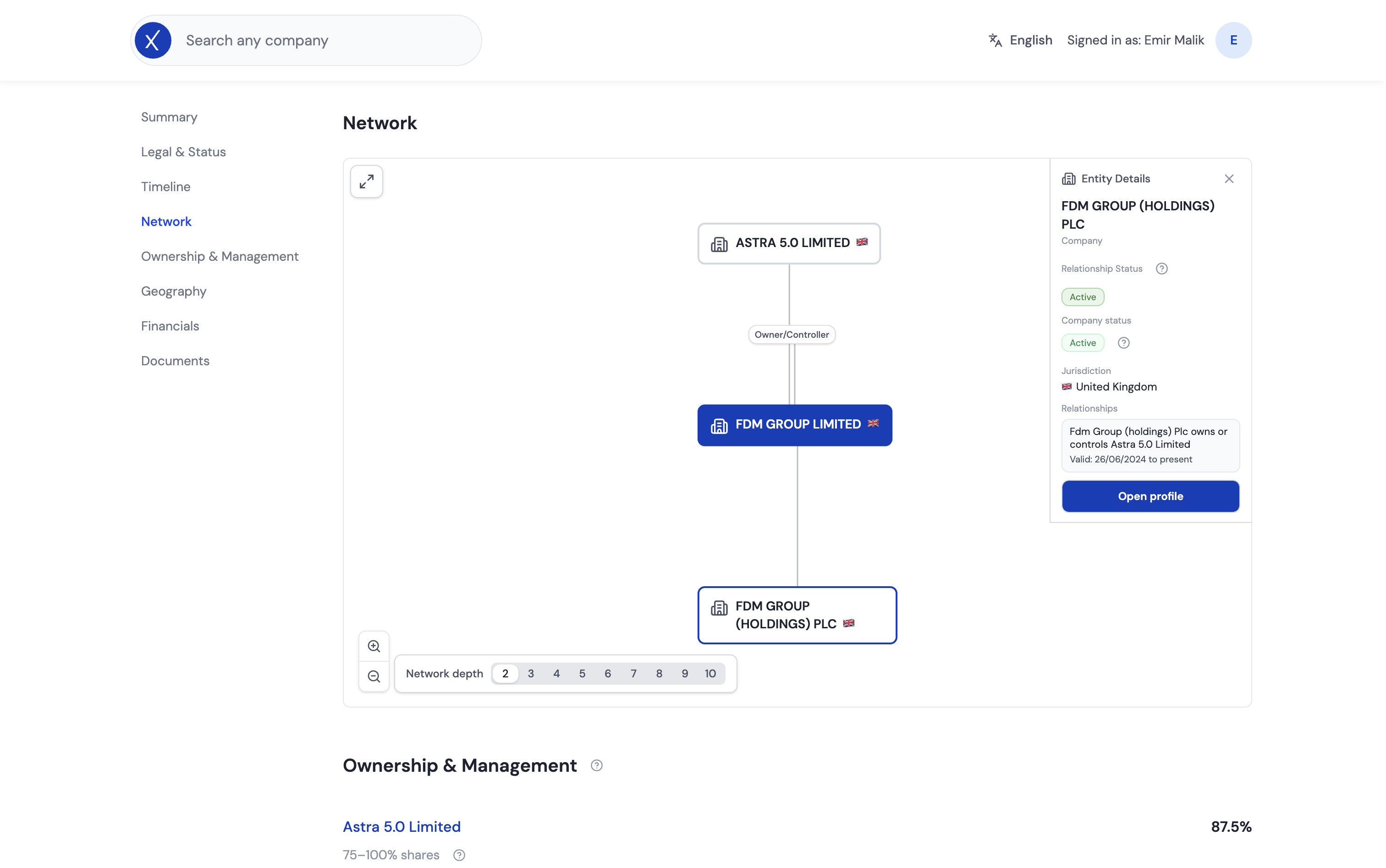
Leadership lists are not the same as ownership evidence. Companexia maps directors, shareholders, and PSCs from registry-backed records, so relationship analysis stays grounded in formal filings.

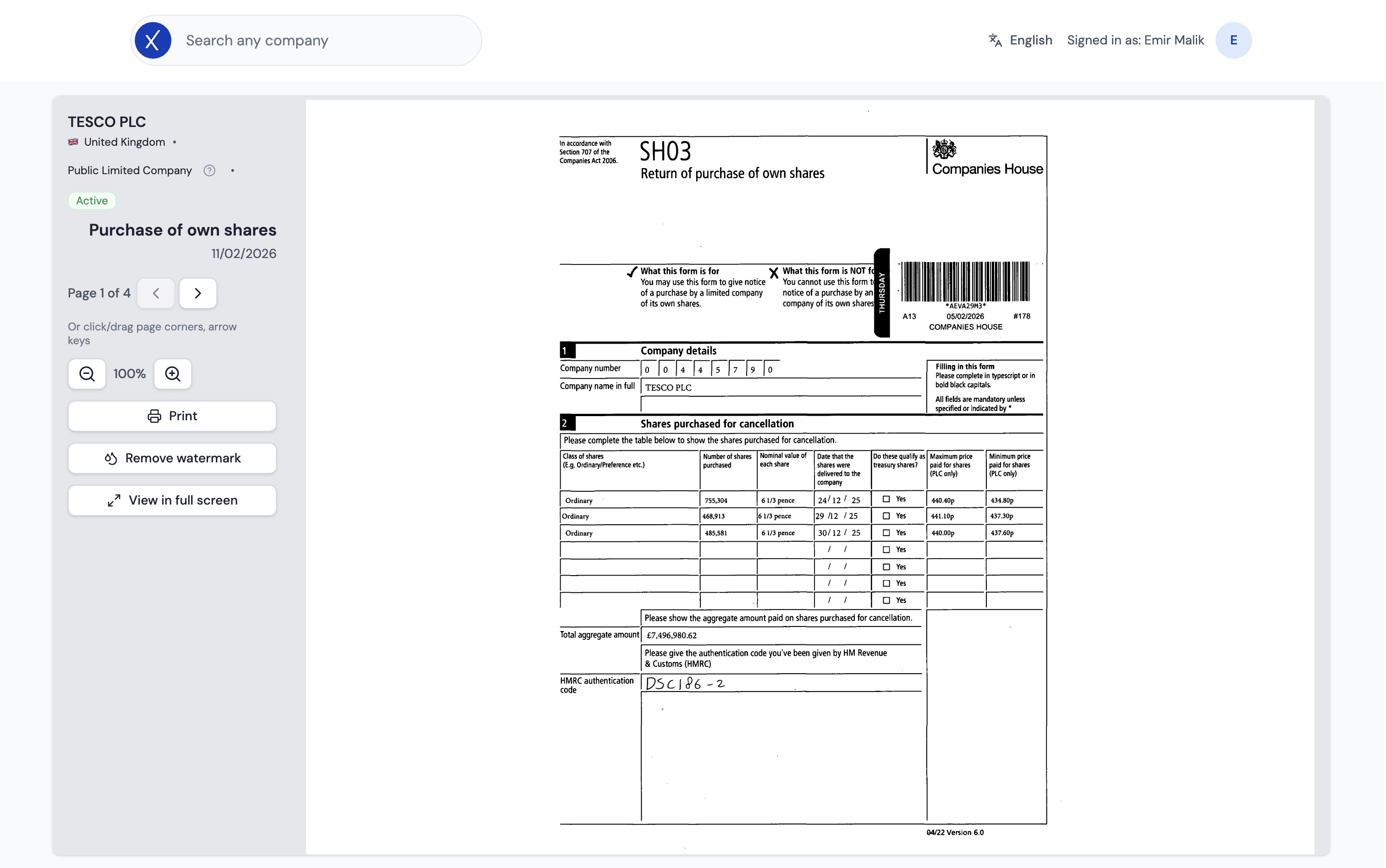
Companexia keeps the underlying registry documents close to the profile. That makes it easier to validate a claim against the filing itself rather than rely on a platform summary.

Incorporations, officer changes, address updates, and filings, organized chronologically with context.
Registered office locations plotted on a map. Useful for verifying addresses and understanding geographic clustering.
Find every company a director or shareholder is linked to, both current and historical, UK and Switzerland.
Teams that need more than a company name and address for UK and Swiss entities.
Verify company status, trace beneficial ownership, and pull official documents in one search. No need to switch between registry sites.
Evaluate a private UK or Swiss company's financial health using calculated ratios and multi-year trends. No expensive data terminal needed.
Pull a company's full filing history, ownership changes, and director appointments in minutes. Structured and downloadable.
Map corporate ownership networks, identify shared directors, and trace company connections across UK and Swiss entities.
Every record comes directly from official registries. No scraped data, no guesswork. New countries coming soon.
Crunchbase is a well-known platform for tracking startups, funding rounds, and the venture capital ecosystem. It provides company descriptions, investor profiles, funding histories, and acquisition data. For sales prospecting and startup research, it's a valuable tool.
Where Crunchbase falls short is official, verifiable company data. Most company profiles on Crunchbase are self-reported or aggregated from news sources, not from government registries. It doesn't provide filed financial accounts, calculated financial ratios, official ownership structures, or government filing documents. For due diligence, compliance, and KYC workflows, this gap is significant.
Companexia fills this gap for UK and Swiss companies. Every data point comes from official sources: Companies House for the UK, Zefix for Switzerland. Financial figures are extracted from filed annual accounts, ratios are calculated automatically, and ownership structures are rendered as interactive network graphs. It's a different kind of company data, built for research and verification rather than prospecting.
Companexia extracts financial figures from filed annual accounts (iXBRL for UK, SOGC publications for Switzerland) and calculates key ratios automatically: current ratio, equity ratio, return on assets, year-over-year growth in profit/loss and total assets, and compound annual growth rate. These are grouped into four categories (growth, efficiency, liquidity, and capital structure) and displayed alongside raw figures for every available filing year.
Crunchbase company profiles are largely self-reported or aggregated from news. Companexia data comes exclusively from official government registries.
Crunchbase shows basic team and leadership information, but doesn't provide official ownership data from government filings. Companexia renders ownership structures as interactive network graphs sourced from Companies House and Zefix, with adjustable depth from 2 to 10 levels.
Crunchbase is the better tool for tracking the startup ecosystem, identifying investors, and sales prospecting. Companexia is the better tool for verifying company data from official sources, analyzing financial health, and tracing ownership structures. Many teams use both: Crunchbase for discovery and Companexia for verification.
Companexia sources UK data directly from Companies House and Swiss data from Zefix (the official Swiss commercial register). Financial figures are extracted from filed annual accounts. Ratios and health scores are calculated by Companexia's analysis engine. Every company profile displays a "Last updated" timestamp tied to the most recent registry sync.
Common questions about using Companexia as an Crunchbase alternative.
Usually not on its own. Crunchbase is stronger for startup discovery, funding rounds, and investor information, while Companexia is built for official company verification, filed accounts, and ownership research. Many teams use Crunchbase for discovery and Companexia for validation.
No. Companexia is not a venture database and does not aim to replicate Crunchbase's funding and investor coverage. Its focus is official registry and filing data for UK and Swiss companies.
Companexia is built from official sources, not self-submitted company profiles. UK data comes from Companies House, and Swiss data comes from Zefix and related official records.
Yes, if the company is registered in the UK or Switzerland, it can appear in Companexia. What you will not get is startup-specific ecosystem data such as funding history, investor networks, or market maps.
Currently Companexia covers the United Kingdom and Switzerland. It is designed for deeper research in those jurisdictions rather than broad global coverage.
No. Company profiles, financial analysis, ownership views, and documents are available without registration or sign-up.
Companexia syncs with its source registries regularly. Each company profile shows a last updated date tied to the most recent registry sync.
Move from profile-style startup data to registry-backed company facts, filings, ownership, and financial context.